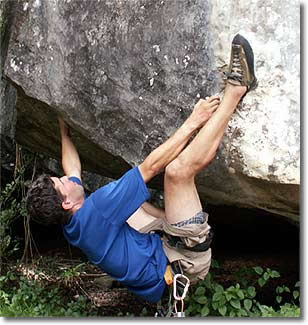
 Rock Climbing in Phang Nga Province
Rock climbing in Thailand consists for the most part of sport climbing in a few crowded areas such as Krabi, Railay, Ton Sai and Phi Phi in Southern Thailand and less crowded climbing routes in Chiang Mai in the North. However, there are endless opportunities to expand climbing holidays in other parts of Thailand.
Phang Nga Province, for example, is a region bursting with massive limestone karst mountains. Almost no one goes to any of the many stunning mountains and cliffs in this huge province. We offer rock climbing trips to a small park near Phang Nga Town to climb a nice variety of bolted routes. This is an easy rock climbing trip from Phuket or Krabi.
Many unexplored cliffs are just waiting to be discovered. So, if you’ve ever dreamed of being the first person to go up a new climbing route, then read on.
Our climbing goals are not based solely on the climb. Solitude, a direct connection with the stunning limestone karst formations and the challenge of pushing your personal limits, no matter whether they are mental or physical, are all part of the climbing experience.
One of our favorite places to climb is Koh Yao Noi in Phang Nga Bay. There are dozens of bolted routes and trad routes are also available. The bolted routes are bolted with titanium glue-in bolts primarily, especially at the lower levels.
In addition to technical rock climbing trips, we offer tropical mountaineering (and for further information click here and here too) and often incorporate technical rock climbing on these climbing routes.
The top of many of the mountains in Phang Nga Province reveal breathtaking scenery. From the tops of some mountains, you’ll see world famous Phang Nga Bay. See some more rock climbing images from Koh Yao Noi here. From other sides you’ll see the lush valley that lies to the north of the ridge of mountains that traverse east and west. Therefore, we concentrate on alpine-style climbing with the goal of not only enjoying the climbing, but to see what's on the top and over the other side.
Rock climbing emphasizes skills such as rope management, anchoring, belaying, rappelling, protection placement, climbing technique, and safety. You will also develop a sound foundation in backwoods ethics.
 Trad Climbing
Traditional or Trad Climbing involves asccending rock climbing routes which do not have permanent anchors (or bolts) to help the climbers.
Limestone can be difficult rock for placing traditional protection. Some rock can break easily and even strong-looking rock can conceal a layer of softer rock behind it. Therefore, it is imperative that all precautions be taken when approaching a new route.
Placing protection, traditional climbing, is an art form. It is as much a part of the climb as the climbing itself. If you are interested in leading a trad route, you should first practice placing pro at lower levels and testing it.
Your goal should be to get to the point where you can look at possible placements and you automatically identify the appropriate protection that should be used.
Placing pro quickly is also vital as you will often be tired and you will need to free one hand to place the pro. Flowing with your climbing should be paramount.
The best climbers don’t stop; they seem to flow from one move directly into the next. Therefore, plan your moves ahead of time and place your protection quickly so you can keep things moving. It is a good idea to visualize your moves while you are still on the ground.
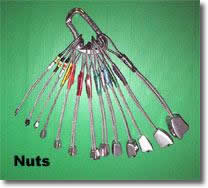 You will also benefit greatly from seconding an experienced climber. This enables you to learn proper placements and it also develops skills in removing protection.
Climbing using traditional protection is a very rewarding experience. This can be as safe as sport routes if you take the time to learn how to place protection properly.
Additionally and just as important, traditional rock climbing leaves the rock the natural... nothing is left behind other than perhaps some chalk marks, which wash away with the next rain.
Being environmentally-conscious, we always strive to minimize our impact on the natural world. Leave nothing behind.
 Sport Climbing
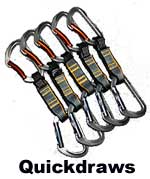
Though on a certain level we feel that bolting detracts from the climbing experience, we are not at all opposed to doing it for reasons of safety or in cases when routes are climbed repeatedly. A well-placed bolt can be absolutely bomber! In questionable limestone, this is often the safest option.quickdraws for sport climbing
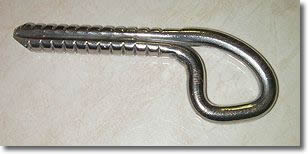 Sport climbers carry much less gear up a rock. Basically, they take what’s known as quickdraws. These are two carabiners with a sewn webbing sling between them. Bolted routes have metal bolts pre-placed (in a drilled hole) into the rock. Sometimes these are glued in and other times these are expansion bolts. A bolt hanger is attached to the bolt and that is where you clip in.
In saltwater environments, such as Phang Nga Bay (Koh Yao Noi) even marine-grade stainless steel bolts corrode. The electrolysis-induced corrosion factor in limestone is very high. Thus, many of these bolts have been replaced with glue-in titanium bolts. Click here to see some rock climbing photos from Phang Nga Bay.
We don't climb on anyone else's bolts unless we know who placed them and when they were placed. The reward is not worth the risk. In Phang Nga Province this is not nearly as serious as there isn’t the salt air contributing to the corrosion.
 Top Roping
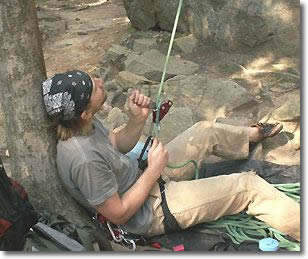
Many if not most climbers start off by learning on a top rope. This is where a rope is already set (anchored) above the intended climb. The belayer is at ground level (usually) and the climber climbs with the confidence that if he/she falls, it will be very minimal in length. A climber can also practice really difficult moves when top roping for the same reason.
Another important skill is down climbing. Down Climbing requires the use of different muscles than those used in climbing up. Some climbers get anxious or concerned more about climbing down than up. This is a good time to try top roping. With this setup, a climber can be confident since falls will not be serious.
Knowing how to climb down is also an important skill for trad climbing leaders as there are sometimes cases when a leader must climb back down to a piece of protection to either move it, shift it or possible eliminate it.
One common practice in sport climbing is to climb until you fall off. This is certainly not something that a climber should do when trad climbing. This is yet another reason why knowing how to down-climb and feeling confident in down climbing is important.
 Aid Climbing
Aid climbing means placing protection and using that protection to aid in climbing. In other words, gear is used to get up and down the rock.
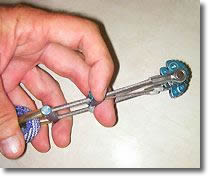
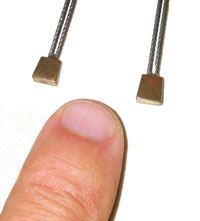
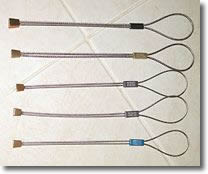
 Aid climbing is often incorporated in our exploratory trips and some traditional climbing routes when unclimbable areas are reached. Small cracks that are too tiny for fingers to enter are one of the examples where aid climbing becomes necessary. Micro-stoppers (pictured right) are often placed in extremely thin cracks and you rely on these to 'aid' you up the rock.
Aid climbing is a discipline within the climbing community and it attracks climbers who are interested in engineering and problem solving.
 It's also for those interested in learning trad climbing as it helps you learn how to place gear/protection. It also helps build your confidence in your gear placement.
Aid climbing also has its own rating system. Don't think for a second that aid climbing is 'cheating' or it's easy... it's not. Aid climbing is often used to climb tricky roofs, over-hangs and extremely challenging sections of rock.
Not many rock climbing tour operators offer aid climbing for whatever reason. We find it challenging, inspiring, and a wonderful way to get beginners interested in traditional rock climbing.
Short Rock Climbing Trips
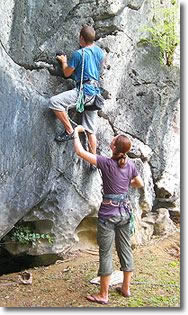 If you have limited time and would like a one-day or a two-day rock climbing trip, we offer a get-away to Phang Nga Town. Just an hour from Phuket or Krabi, Phang Nga Town has retained its charm and character. Phuket rock climbing This off-the-beaten-path destination gets very few foreign tourists, isn't full of bars and it's quiet. There is a small park at the edge of town with a lot of bolted routes. Most routes are 5a to 6b, but there are easier and harder routes too. If you don't like the thought of standing in line to get on a climb in Krabi, escape to Phang Nga Town with us.
You have the opportunity to join us as we explore Phang Nga Province’s limestone cliffs. Feel the freedom and the sense of accomplishment that comes with getting a hands-on experience on the cliffs of Phang Nga Province.
You can join us if you are moderately fit and, of course, not afraid of heights. No previous climbing experience is needed. First-timers are more than welcomed to join us. It's fun and you don't have to do anything that you're not comfortable with. Click here to see a rock climbing grade conversion chart.
Rock climbing trips can be added to your Phang Nga Bay kayaking tour, Khao Sok kayaking adventure tour or booked as a stand-alone tour. Contact us for details and pricing.
Budget Rock Climbing
If you're on a budget and want to climb on Koh Yao Noi or in the small park outside of Phang Nga Town, we offer rock climbing tours whereby all you pay for is the guiding service. You can stay wherever you want, eat whatever you want, and so on. Complete details here.



Note: All safety precautions are taken, but the very nature of this sport includes some risk. However, risks can be minimized by proper skills training.
Legal note: It is illegal for a foreigner to be a guide in Thailand. A licensed Thai guide is required by law to accompany EVERY tour. We respect the law of the land and have a Thai guide on our trips. It is, however, legal to have foreign tour leaders and safety instructors as long as there is also a licensed Thai guide on the trip.
Click here to read a rock climbing trip report from a ten-day tour.
Click here to see a  video of rock climbing in the city park in Phang Nga Town. Please subscribe to my channel.
Guest comment:
We have climbed a couple times together with Dave, both in Phang Nga Town and on Koh Yao Noi, and we loved it.
Phang Nga Town is a park just outside the town where the Thais having their Sunday picnics. The surrounding is quite different compared to Phuket and the rocks protrude majestically.
One of the best things with this park is the easy access, so a perfect place for a short climbing trip, even for a half day. The routes vary in degrees of difficulty, from 5+ and upwards, so everyone can find something to climb, i.e. ideally for groups that are on different levels.
Koh Yao Noi is a peaceful island located in Phang Nga Bay far away from tourist hordes. We really liked the atmosphere on the island, and it's worth a visit even without climbing. But the climbing is fabulous and it's like a Swedish smorgasbord with a lot of deliciousness to grab. "Grateful Wall" became a personal favorite, which is just by the seaside and only reachable by boat (fortunately Dave has his own longtail). The wall offers routes with grade 6a to 6c all bolted with new titanium bolts (as most of the routes in this area). There are a lot of holes in different sizes, which makes it possible to vary the climbing even on the same route.
If you looking forward meeting a lot of other climbers neither of Phang Nga Town or Koh Yao Noi is the right place for you, but if you prefer climbing instead of waiting on your turn they both are great places.
Without Dave´s excellent local knowledge and his good connections, our visits wouldn't be as wonderful as they turned out to be. He is also nice guy and a living one-liner machine, and we enjoyed his company very much.
Thanks a lot, Dave, for make our four month Phuket stay more bearable.
Christoffer & Malin Axelsson (Swedish)
|
"Climbing involves cracks. All else is technical hiking" The Fat Boys Mountaineering Club (Climbing, No. 157, p. 10)
Certification in CPR & First Aid
Dave is an Emergency First Response Instructor and a certified rescue technician through the Rescue 3 International organization. View certifications. All of our professional guides are certified in CPR and First Aid.









 Paddle Asia
and view our videos on
Paddle Asia
and view our videos on 

